

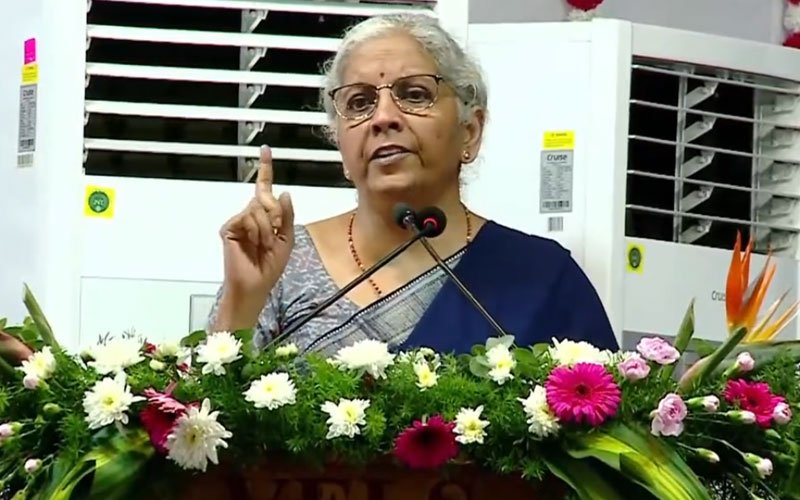
New Delhi: The Union government’s sustained focus on strengthening higher education and skill development infrastructure has resulted in rapid and large-scale expansion across the country, Finance Minister Nirmala Sitharaman’s office said in a post on X (formerly Twitter).
Quoting Sitharaman’s address at the 13th Annual Convocation of VELS University in Chennai on June 30, 2023, the post highlighted striking milestones achieved in India’s education sector over the past decade. According to the data shared, one new university is being established every week, while a new college comes up every second day. The pace of skill development has also accelerated, with one new Industrial Training Institute (ITI) being formed every day and an Atal Tinkering Lab opening every third day to promote innovation and scientific temper among school students.
The tweet further noted that one new Indian Institute of Technology (IIT) is being opened every year, reflecting the government’s emphasis on world-class technical education. As a result of these sustained efforts, the total number of universities and university-level institutions in the country has risen to 1,113, marking a 53 per cent increase from 720 institutions in 2014.
“Higher education is getting the highest priority under the Modi government,” the post stated, underlining the administration’s long-term commitment to building academic capacity and human capital.
This vision was reiterated and expanded upon in the Union Budget 2026, where Sitharaman announced a series of new initiatives aimed at creating integrated academic ecosystems and improving access for women students. Among the key announcements was the establishment of five university townships near major industrial and logistics corridors. These townships are planned as comprehensive academic hubs, hosting multiple universities, colleges, research institutions, skill centres, and residential facilities.
“Our government will support states through the challenge route, creating five university townships in the vicinity of major industrial and logistics corridors,” the finance minister said while presenting the budget. She added that these planned zones would help align higher education with industry needs, research, and employment opportunities.
Addressing gender-related challenges in higher education, Sitharaman also announced that one girls’ hostel will be set up in every district. The initiative aims to support female students, particularly those pursuing STEM courses, where extended laboratory hours and academic demands often create logistical and safety concerns. The hostels will be supported through Viability Gap Funding (VGF) or direct capital assistance.
“In higher education, prolonged hours of studying and laboratory work pose challenges for girl students,” she said, emphasising that improved residential infrastructure would help boost female participation and retention in advanced studies.
Beyond mainstream education, the finance minister also announced enhanced support for astronomy and astrophysics, signalling the government’s intent to promote cutting-edge scientific research and public engagement with science. Under this initiative, four major telescope infrastructure facilities will be set up or upgraded, including the National Large Solar Telescope, National Large Optical Infra Telescope, Himalayan Chandra Telescope, and the Cosmos 2 Planetarium.
Together, these measures reflect a broad and strategic push to modernise India’s education landscape—spanning universities, skill centres, gender-inclusive infrastructure, and advanced scientific research—positioning higher education as a central pillar of national development.