

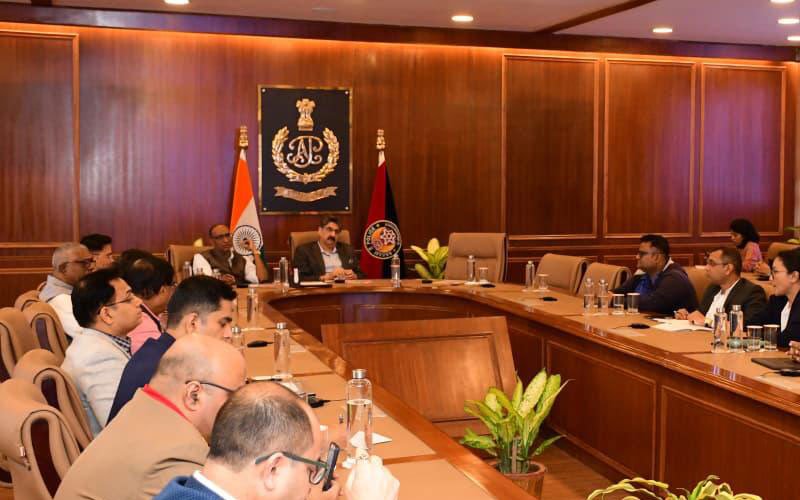
Guwahati, Feb 3: Director General of Police (DGP) Harmeet Singh on Monday chaired a meeting of the State Empowered Committee on the Inter-Operable Criminal Justice System (ICJS) and CCTNS 2.0 at the Assam Police Headquarters (APHQ), underscoring the state’s push towards a fully digital, technology-driven criminal justice ecosystem.
The high-level meeting was attended by senior police officials, including the Special Director General of Police (SDGP), Assam CID. The committee reviewed the progress of various initiatives aimed at ensuring seamless end-to-end digital integration across the criminal justice system, from investigation to prosecution and judicial processes.
According to Assam Police, the meeting focused on accelerating the implementation of e-Forensics 2.0, which is expected to strengthen scientific investigation through advanced digital forensic tools. A key area of discussion was the rollout of the Criminal Profiling Index (CrPI) under CCTNS 2.0, enabling biometric-based identification to improve accuracy in crime detection and criminal tracking.
Officials also reviewed the digital consumption of FIRs and charge sheets by courts, a move aimed at reducing paperwork, enhancing transparency, and speeding up judicial processes. The introduction of e-Summons was discussed as a critical step to ensure faster and more reliable communication between police, courts, and other stakeholders.
Infrastructure readiness under ICJS was another major agenda, with emphasis on improving bandwidth and connectivity across police units and judicial institutions to support uninterrupted digital operations. The committee further highlighted the importance of capacity building of public prosecutors, enabling them to adapt efficiently to digital workflows and technology-enabled case management.
The Assam Police reiterated its commitment to building a smarter, transparent, and tech-enabled justice delivery system, aligning with national digital policing and justice reforms. The initiatives under ICJS and CCTNS 2.0 are expected to significantly enhance coordination among police, forensic agencies, prosecution, and courts, ultimately benefiting citizens through faster and more accountable justice delivery.