

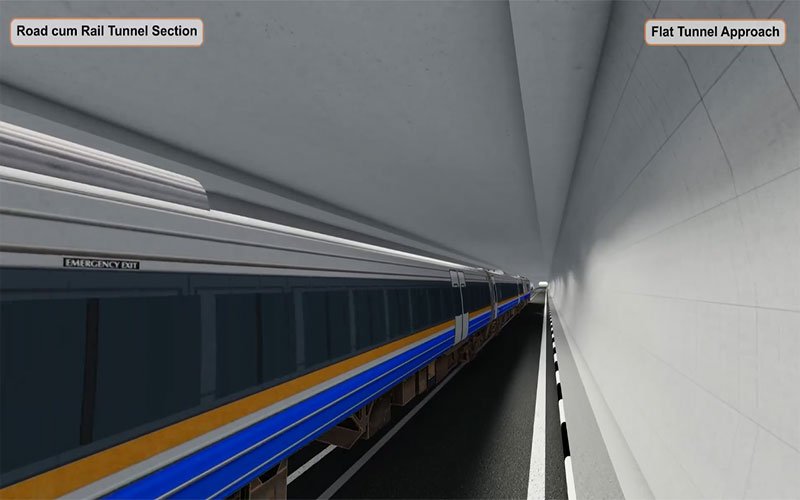
Guwahati: Assam Chief Minister Himanta Biswa Sarma on Saturday highlighted the transformative impact of the upcoming Gohpur–Numaligarh rail-cum-road tunnel beneath the Brahmaputra, calling it a historic and visionary infrastructure project for the state and the Northeast.
In a post on X, Sarma shared a video offering a visual glimpse of the proposed twin tube tunnel connecting Numaligarh and Gohpur, stating that the project is being undertaken for the first time in India. He expressed gratitude to Prime Minister Narendra Modi for his support in turning the long-cherished vision into reality.
“Watch this video to get a visual idea on how the upcoming Twin tube Tunnel connecting Numaligarh and Gohpur will look like. This project is being made for the first time in India and we are eternally thankful to Adarniya @narendramodi ji for his support,” the Chief Minister wrote.
Watch this video to get a visual idea on how the upcoming Twin tube Tunnel connecting Numaligarh and Gohpur will look like.
This project is being made for the first time in India and we are eternally thankful to Adarniya @narendramodi ji for his support in turning this vision… pic.twitter.com/gFVWmkkYtT
— Himanta Biswa Sarma (@himantabiswa) February 15, 2026
In another post, Sarma described the tunnel as a new chapter of connectivity taking shape beneath the Brahmaputra. He underlined its strategic importance, noting that the project would significantly cut travel time and serve as a crucial lifeline for India’s defence forces.
“The Gohpur–Numaligarh rail-cum-road tunnel will cut travel time and serve as a strategic lifeline for our defence forces. Grateful to Adarniya Shri @narendramodi ji for this transformative gift to Assam,” he added.
Cabinet Approval and Project Details
The statements came after the Cabinet Committee on Economic Affairs (CCEA), chaired by Prime Minister Narendra Modi, approved the construction of a 4-lane access-controlled greenfield corridor from Gohpur (NH-15) to Numaligarh (NH-715) in Assam. A key component of the project is a 15.79-km road-cum-rail tunnel beneath the Brahmaputra River.
The ambitious corridor will be developed at a total capital cost of Rs 18,662 crore under the Engineering, Procurement and Construction (EPC) mode.
At present, connectivity between Gohpur and Numaligarh requires a detour of nearly 240 km via the Kaliabhambhora bridge near Silghat on NH-52, taking almost six hours and passing through ecologically sensitive and congested areas such as Kaziranga National Park and Biswanath town.
Once completed, the new corridor will reduce the distance to about 34 km, cutting travel time dramatically to around 20 minutes.
Act East Policy and Regional Impact
Union Railway Minister Ashwini Vaishnaw said the project is closely aligned with the NDA government’s Act East Policy and will have far-reaching benefits for the entire Northeast.
“The 240 km will become 34 km. The six-hour journey will be reduced to just 20 minutes. The average speed will double, and high-speed connectivity will link Assam and Arunachal Pradesh. The entire Northeast will benefit across economic activity, tourism, healthcare and education,” Vaishnaw said.
Echoing these sentiments, Chief Minister Sarma termed the approval a “historic milestone” for Assam.
“A historic milestone for Assam—Bharat’s first twin tube underwater rail-cum-road tunnel approved. Gratitude to Adarniya @narendramodi ji-led Union Cabinet for approving the 33.7 km 4-lane corridor from Gohpur to Numaligarh, including a 15.79 km tunnel beneath the mighty Brahmaputra River, at a cost of Rs 18,662 crore,” he posted.
First in India, Second in the World
The 15.79-km tunnel will be India’s first underwater road-cum-rail tunnel and only the second such tunnel in the world. The alignment will integrate two major national highways—NH-15 and NH-715—and connect with key railway sections under the Northeast Frontier Railway. These include the Rangia–Murkongselek section on the Gohpur side and the Furkating–Mariani loop line on the Numaligarh side.
Designed as a multi-modal infrastructure project, the corridor will link 11 economic nodes, three social nodes, two tourist nodes and eight logistics nodes. It will also improve access to four major railway stations, two airports and two inland waterways, enabling faster and more efficient movement of goods and passengers.
Economic, Strategic and Employment Benefits
Officials said the project would significantly enhance freight efficiency, reduce logistics costs and accelerate socio-economic growth across Assam and the wider Northeast region. Its strategic importance is also expected to strengthen connectivity to border areas and improve defence mobility.
The government estimates that construction of the corridor will generate nearly 80 lakh person-days of direct and indirect employment, providing a substantial boost to the regional economy.
Describing it as a strategically significant initiative, officials noted that the tunnel will open new avenues for trade, industrial development and regional integration, firmly placing Assam at the heart of India’s infrastructure-driven growth in the Northeast.