

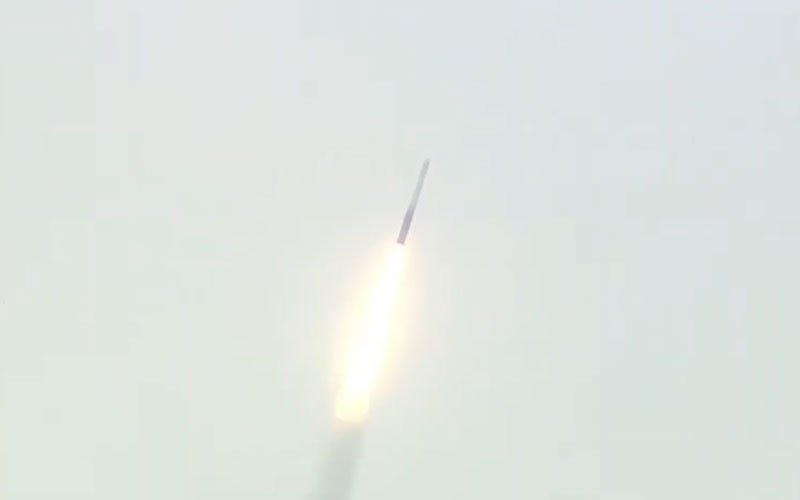
Sriharikota (Andhra Pradesh): In a landmark achievement for India’s private space industry, Hyderabad-based Skyroot Aerospace on Saturday successfully launched its Vikram-1 rocket into orbit, becoming the first private Indian company to achieve an orbital launch with an indigenously developed rocket.
The mission, named ‘Aagaman’, lifted off from the Satish Dhawan Space Centre after a brief planned hold in the countdown. Although the launch was initially scheduled for 11:30 am, the rocket took off at 12:05:30 pm, with mission officials confirming the successful placement of its payload into the intended orbit at approximately 12:21 pm.
The successful mission marks a significant milestone in India’s space programme, underscoring the growing role of private enterprises in satellite launch services and advanced space technologies.
Vikram-1, named in honour of Indian space pioneer Dr Vikram Sarabhai, is a seven-storey, multi-stage orbital launch vehicle developed entirely by Skyroot Aerospace. Constructed using lightweight carbon composite materials, the rocket incorporates indigenously developed propulsion systems, including solid-fuel stages and advanced 3D-printed engines.
The launch vehicle has been designed to carry satellites weighing up to 350 kilograms into Low Earth Orbit (LEO). During its maiden orbital mission, Vikram-1 targeted an altitude of about 450 kilometres with a 60-degree orbital inclination, demonstrating its capability for future commercial satellite launches.
Among the payloads onboard were technology demonstrators from Grahaa Space, Cosmoserve, DCubed, and Skyroot’s own SCOPE platform. The rocket also carried “Cosmic Bloom,” an artistic creation by Cosmos Diamonds, as well as a micro-art installation featuring miniature sculptures of Sir C.V. Raman, Dr Vikram Sarabhai, and Dr A.P.J. Abdul Kalam, celebrating India’s scientific legacy.
Prime Minister Narendra Modi congratulated the Skyroot Aerospace team ahead of the launch, describing the mission as “a historic new frontier” in India’s space journey. He said the initiative reflected the country’s expanding innovation ecosystem and highlighted how reforms in the space sector were encouraging entrepreneurship and technological advancement.
As part of the mission, Vikram-1 also carried a commemorative postcard bearing the Prime Minister’s handwritten message, “Vande Mataram,” along with hundreds of messages submitted by people across the world. In tribute to the people behind the project, the rocket additionally carried the signatures of Skyroot’s engineers, technicians and other team members.
Skyroot Aerospace had earlier demonstrated its launch capabilities through the successful Vikram-S suborbital mission in 2022. With Vikram-1 now completing an orbital mission, the company has taken a major step towards establishing India as a competitive player in the global commercial launch market.
The successful flight is expected to boost confidence in India’s private space ecosystem and reinforce the country’s efforts to expand indigenous launch capabilities while supporting the growing demand for cost-effective satellite deployment services.