

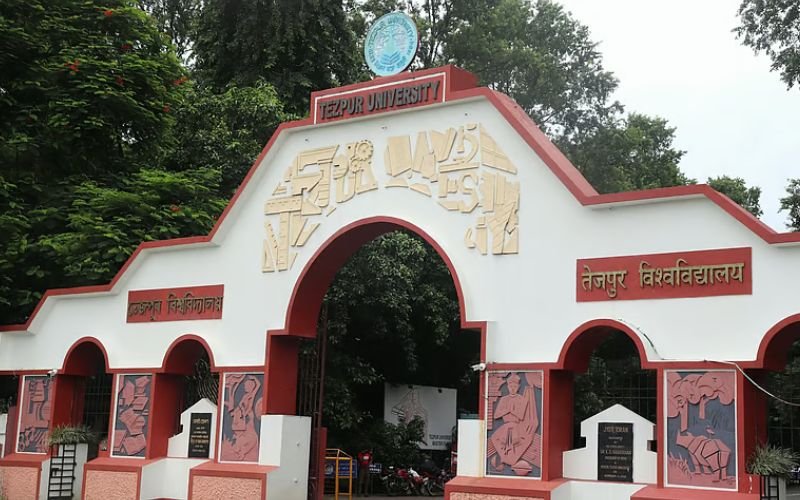
Scientists from Tezpur University have made an important breakthrough in explaining how energy travels through the Sun, a discovery that could help improve predictions of solar storms that affect satellites, power infrastructure and communication systems on Earth.
The research, published in The Astrophysical Journal, was carried out by Souvik Das, Senior Research Fellow under the DST-INSPIRE programme, under the supervision of Prof Pralay Kumar Karmakar from the Department of Physics. The study focuses on the Sun’s continuous vibrations, caused by sound-like waves known as five-minute solar oscillations, which make the Sun behave like a resonating object.
While scientists have long believed that these oscillations play a role in transferring energy from the Sun’s surface to its atmosphere, the exact mechanism had remained unclear. The Tezpur University team addressed this gap by developing an advanced theoretical model that incorporates both low-energy and high-energy electrons present in solar plasma.
The study shows that high-speed non-thermal electrons can significantly alter solar oscillations and affect the flow of energy into the Sun’s lower atmosphere. Strong non-thermal effects were found to weaken pressure-driven p-mode oscillations. As the population of high-energy electrons increases, overall wave activity decreases, indicating that energetic particles can suppress certain waves while redistributing acoustic energy.
Researchers believe this redistributed energy contributes to the formation of spicules, microspicules and atmospheric waves, which play a key role in heating the Sun’s chromosphere and corona — outer layers that are much hotter than the visible surface.
Explaining the significance of the findings, Souvik Das said the study reveals that some fast oscillations on the Sun’s surface can carry more energy than previously estimated, while others are suppressed due to strong non-thermal effects. This balance helps scientists better understand how energy is regulated within the Sun’s atmosphere.
The team also proposed a new hybrid decay model to explain how energy gradually weakens as it moves upward through the Sun’s atmosphere. These theoretical results were validated using observational data from NASA’s Solar Dynamics Observatory and Japan’s Hinode Solar Optical Telescope.
Prof Pralay Kumar Karmakar said the research successfully connects theoretical models with real observational data and offers fresh insights into solar energy transport, which is essential for improving space weather forecasting.