

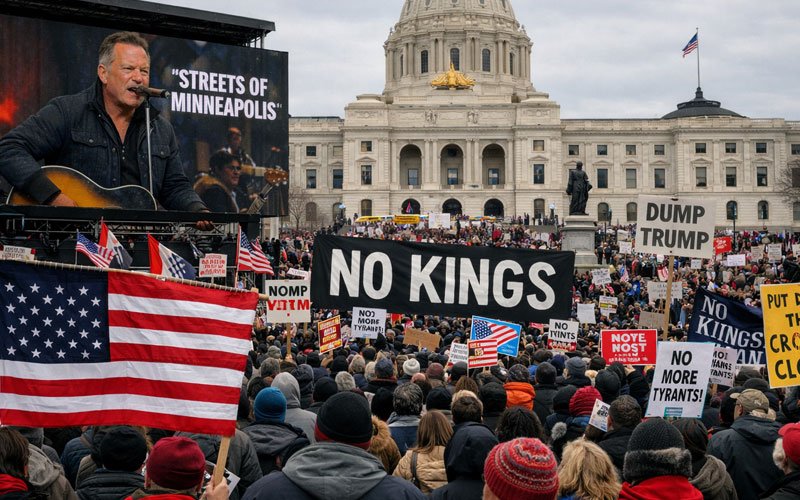
Washington/Minneapolis, March 29: Massive protests erupted across the United States and parts of Europe on Saturday as millions of people joined coordinated “No Kings” rallies opposing the war in Iran and the policies of former US President Donald Trump.
Minnesota emerged as the focal point of the demonstrations, with tens of thousands gathering at the State Capitol in St. Paul. Protesters filled the Capitol lawn and nearby streets, some holding upside-down American flags as a symbol of national distress.
The Minnesota rally featured a high-profile performance by Bruce Springsteen, who debuted his song “Streets of Minneapolis.” The track was written in response to the fatal shootings of two civilians by federal agents and as a tribute to widespread protests against immigration enforcement. Addressing the crowd, Springsteen condemned recent developments, stating that public resistance offers hope for preserving democratic values.
Demonstrations were reported across all 50 states, from major cities like New York to smaller towns such as Driggs, Idaho. Organisers estimated participation could reach up to 9 million people, surpassing earlier rallies that drew 5 million in June and 7 million in October. More than 3,100 events were registered nationwide.
In Washington, hundreds marched from the Lincoln Memorial to the National Mall, chanting slogans like “No kings” and carrying placards criticising authoritarianism. In San Diego, police reported around 40,000 participants.
The protests reflected a wide range of grievances, including immigration crackdowns, the Iran conflict, and the rollback of transgender rights. Demonstrators used both satire and symbolism, with some dressing in costumes mocking federal agencies.
However, the rallies drew sharp criticism from the administration and Republican leaders. White House spokesperson Abigail Jackson dismissed the protests as driven by “leftist funding networks,” while the National Republican Congressional Committee described them as platforms for extreme rhetoric.
Prominent figures including Robert De Niro, Joan Baez, Jane Fonda, and Bernie Sanders also voiced support, either through appearances or messages.
The protests extended beyond the US. In Rome, thousands marched against war and government policies, while demonstrations were also held in London and Paris, where participants criticised global conflicts and rising right-wing politics.
Organisers said the movement has gained traction even in conservative regions, highlighting growing nationwide discontent. Internationally, similar protests were branded as “No Tyrants” in countries with constitutional monarchies.
As the demonstrations continue to expand globally, organisers say the movement represents a collective stand against authoritarianism and war, with Minnesota symbolising the epicentre of resistance.