

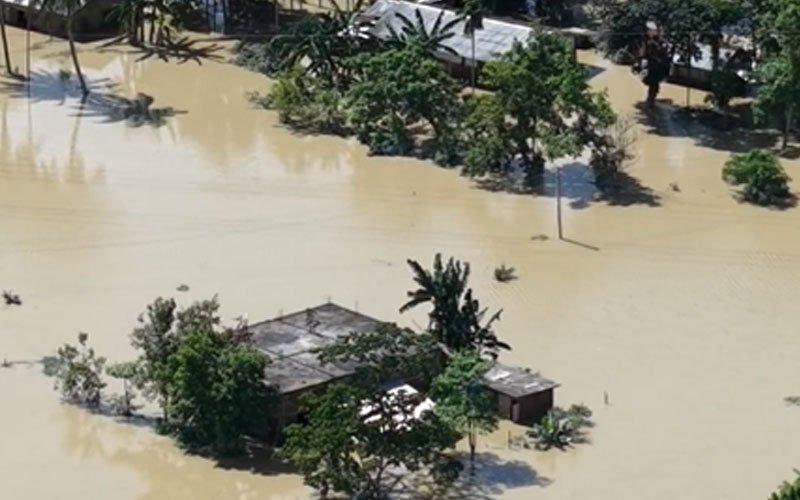
Sivasagar, July 28: Even as floodwaters continue to recede across parts of Upper Assam, thousands of families in Sivasagar are confronting a new crisis. Homes remain coated in thick layers of silt, drinking water sources have been contaminated, dead livestock are scattered across villages, and many residents are still unable to return to their houses.
The worsening post-flood conditions come as a five-member Inter-Ministerial Central Team (IMCT) visited Sivasagar on Monday to assess the scale of destruction caused by one of the state’s worst flood disasters in recent years. The team held meetings with district officials and reviewed the damage in the presence of Assam ministers Bimal Borah and Keshab Mahanta.
Although water levels have dropped in several areas, many villages continue to remain partially submerged. In Baksu and Bokolgaon under the Demow area, residents said floodwater has remained inside their homes for more than a week, leaving behind damaged furniture, household belongings and thick deposits of mud. Many displaced families are currently taking shelter with relatives as their homes remain uninhabitable.
A similar situation persists in Kashibari village, where residents continue to live in difficult conditions. With tube wells submerged, access to safe drinking water has become a major concern, forcing villagers and their livestock to take refuge on elevated areas near a bridge.
In another severely affected locality, nearly 150 families are struggling to rebuild their lives after floodwaters receded, leaving homes and courtyards buried under heavy silt. Residents said the overflowing waters from the nearby Naga Hills swept away several houses, sparing only a handful of concrete structures.
Speaking to reporters, Sivasagar district’s minister-in-charge Bimal Borah said the floods affected more than four lakh people across 385 villages. He stated that 31 people have lost their lives in the district, while three others remain missing. Rescue operations carried out jointly by the SDRF, NDRF, district administration, local volunteers, the Indian Army and the Indian Air Force helped evacuate over 20,500 people, using 121 boats during the emergency response.
Borah added that the disaster caused extensive damage to public infrastructure and livelihoods. Around 66,000 livestock and 75,000 poultry were affected, while 158 kilometres of roads, 350 schools, 462 Jal Jeevan Mission projects, and nearly 12 kilometres of embankments suffered damage.
Revenue and Disaster Management Minister Keshab Mahanta said the Centre had dispatched the assessment team much earlier than usual following a request from Chief Minister Himanta Biswa Sarma to Prime Minister Narendra Modi and Union Home Minister Amit Shah. He noted that the statewide flood death toll had reached 68 as of Monday morning.
Beyond the government’s relief operations, voluntary organisations, youth groups, clubs and individual citizens have stepped forward to support affected communities. Relief materials, including food grains, drinking water, clothing, hygiene products and other essentials, continue to reach flood-hit villages through community-led collection drives organised across Assam, including in Guwahati.
The immediate threat from floodwaters may be easing, but for thousands of families, the road to recovery has only just begun as they grapple with damaged homes, sanitation concerns and the daunting task of rebuilding their lives.