

Siliguri, July 19: Union Home Minister Amit Shah on Saturday announced a renewed push to modernise security along the India-Bangladesh border, outlining a series of measures focused on advanced surveillance, infrastructure development and stronger coordination among security agencies during a day-long review in West Bengal’s Siliguri.
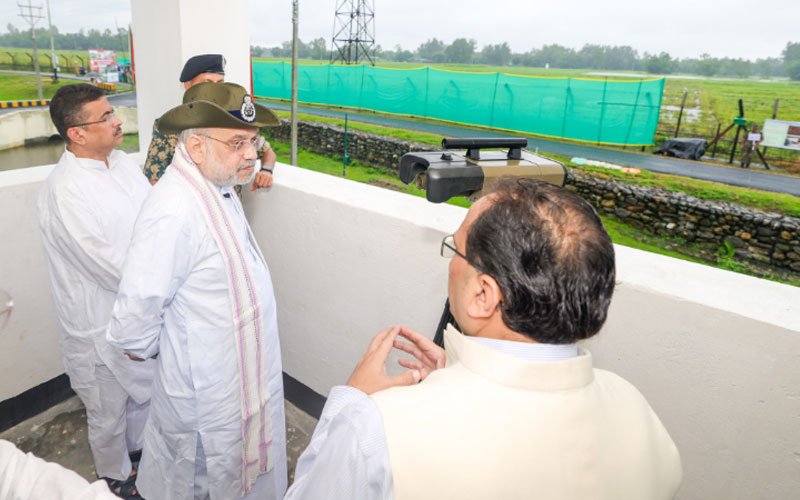
The Home Minister visited the Border Security Force’s (BSF) Jumagachh Border Out Post (BOP), where he inspected surveillance arrangements from a watch tower and assessed the technological systems deployed to monitor the international border.
Sharing details of the visit on X, Shah said the Centre has significantly strengthened security in the strategically important Siliguri Corridor by expanding surveillance infrastructure and introducing modern technologies.
“What was once a corridor of infiltration under previous governments in the Siliguri Corridor is now becoming synonymous with a secure border,” Shah said in his post.
He added that the government has increased the number of watch towers along the border and equipped them with state-of-the-art surveillance systems to improve real-time monitoring and enhance operational effectiveness.
As part of the visit, Shah also attended the Border Guarding Conference at the Jumagachh Border Outpost, where he met BSF personnel and reviewed their operational preparedness. During the programme, he inaugurated and laid the foundation stone for several BSF infrastructure projects aimed at strengthening border management.
The Home Minister examined demonstrations of multiple indigenous security technologies deployed along the border, including the Intruder Warning System, Radio-based Fence Intrusion Detection System, Gate Management Software and the Indigenous Border Security System integrated with the newly designed border fencing.
According to Shah, the deployment of these modern systems represents the government’s continued efforts to improve border surveillance through technology-driven solutions while supporting the operational requirements of frontline security forces.
Later in the day, Shah chaired a high-level review meeting in Siliguri to assess security challenges along the India-Bangladesh border. The discussions covered issues such as illegal infiltration, narcotics trafficking, economic offences and measures to strengthen coordination between agencies responsible for safeguarding the international border.
Reaffirming the Centre’s security policy, Shah said the Modi government is pursuing a zero-tolerance approach against cross-border crimes and illegal infiltration. He also announced that infrastructure projects related to national security that have remained pending in West Bengal would now be implemented on a priority basis.
The Home Minister further said that a quadrilateral security grid would be established to improve coordination among security agencies and reinforce surveillance across the border region. According to him, the proposed framework is expected to enhance response capabilities and strengthen overall border security.
The Siliguri Corridor, often referred to as the “Chicken’s Neck” due to its strategic importance, serves as the narrow land link connecting India’s northeastern states with the rest of the country. Given its geographical significance, the corridor remains a key focus area for national security and border management.
Shah’s visit underscores the Centre’s ongoing emphasis on combining technology, infrastructure upgrades and institutional coordination to strengthen border security. The government has indicated that modern surveillance systems, indigenous security technologies and improved operational infrastructure will continue to play a central role in safeguarding India’s international borders while addressing challenges such as infiltration, smuggling and organised cross-border crime.