

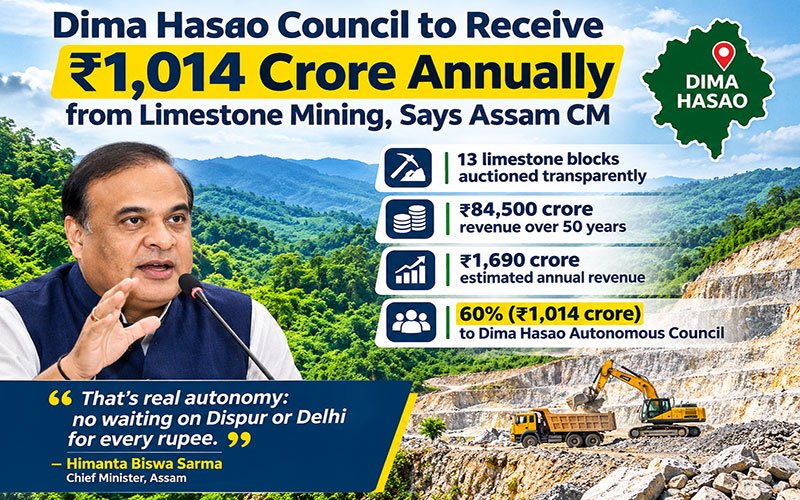
Assam Chief Minister Himanta Biswa Sarma says the auction of 13 limestone blocks could generate Rs 84,500 crore over 50 years, with 60 per cent of the projected revenue earmarked for the Dima Hasao Autonomous Council.
Guwahati, November 2, 2026: Mineral resources in Assam’s hill district of Dima Hasao could become a major source of revenue for its autonomous administration, with Chief Minister Dr Himanta Biswa Sarma outlining a plan that would provide the Dima Hasao Autonomous Council (DHAC) with an estimated Rs 1,014 crore annually from limestone mining.
The Chief Minister shared the financial projections on social media platform X on Monday, highlighting the potential economic benefits of commercial limestone extraction in the district.
According to Sarma, the Assam government has conducted auctions for 13 limestone blocks, attracting leading companies from the cement manufacturing industry. He maintained that the allocation process was carried out transparently.
Limestone Auctions Expected to Generate Rs 84,500 Crore
The Chief Minister estimated that the auctioned limestone blocks could generate approximately Rs 84,500 crore in revenue over the next 50 years.
Based on these projections, the mining operations would yield an average of Rs 1,690 crore annually. Under the revenue-sharing arrangement outlined by Sarma, the autonomous council would receive 60 per cent of this amount, equivalent to approximately Rs 1,014 crore per year.
The proposed allocation would give the council access to a substantial source of locally generated income, potentially strengthening its ability to finance infrastructure, public services and development initiatives.
However, the figures remain long-term revenue estimates, and actual annual collections would depend on mining operations and revenue realisation.
Revenue-Sharing Plan Aims to Strengthen Financial Autonomy
Sarma presented the arrangement as an important step towards greater financial independence for Dima Hasao’s autonomous administration.
He argued that access to a dedicated revenue stream would allow the council to undertake development programmes with less reliance on periodic financial assistance from the Assam government or the Centre.
The Chief Minister also linked the initiative to the district’s economic transformation, pointing to Dima Hasao’s history of insurgency and the opportunities associated with industrial investment.
He maintained that commercial activities in indigenous regions could support local development when a significant proportion of the resulting revenue remained with local institutions.
Industrial Expansion and Environmental Concerns
The limestone revenue announcement comes amid expanding cement industry investments in Dima Hasao.
On October 30, Sarma laid the foundation stone for JK Lakshmi Cement’s proposed Rs 11,000-crore project at Umrangso. The project includes limestone mining and cement manufacturing facilities, with investment planned in multiple phases.
The expansion of mining and cement production has also raised environmental concerns among sections of the local population. Residents in parts of Dima Hasao have previously objected to proposed industrial activities over potential effects on water resources, land and the surrounding environment.
These concerns highlight the importance of environmental safeguards and local participation as industrial development progresses.
A Potential New Source of Development Funding
The projected limestone revenue could significantly expand the financial capacity of the Dima Hasao Autonomous Council if the mining projects deliver the anticipated returns.
For the hill district, the proposed revenue-sharing model would connect mineral extraction more directly with local administration and development financing.
The long-term impact will depend on the implementation of mining projects, the actual revenue collected and how effectively the council uses its share of the proceeds.