

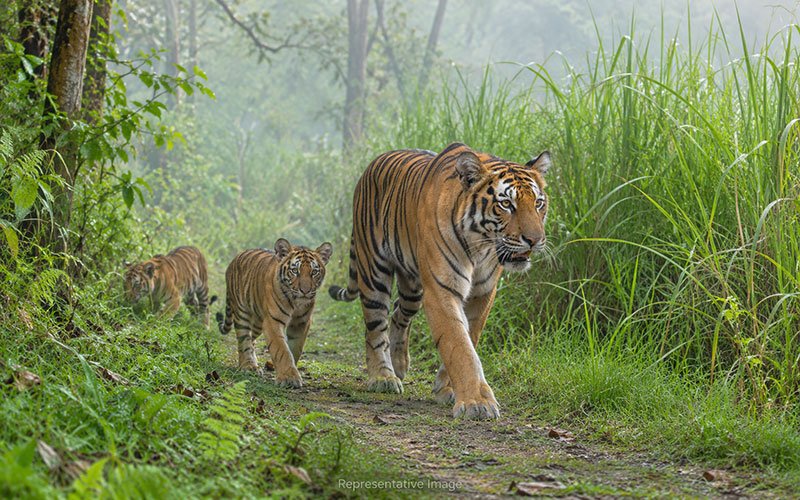
Kaziranga, Assam: A curious tiger cub looking towards a safari vehicle has become the centre of attention in a remarkable wildlife video reportedly captured inside Assam’s Kaziranga National Park and Tiger Reserve.
The footage, said to have been recorded in the Kohora Range, features a Royal Bengal tigress accompanied by her two young cubs as they move through a forest trail surrounded by dense vegetation.
The reported encounter offers a rare glimpse into the behaviour of a tiger family in the wild, where these elusive predators generally remain concealed from visitors.
Curious Cubs Make Kaziranga Wildlife Encounter Memorable
According to descriptions accompanying the video, the mother tigress was moving along a forest path during an afternoon safari when her two cubs followed closely behind.
One of the young tigers reportedly stopped for a moment and turned towards the safari vehicle, appearing curious about its surroundings.
The second cub was described as remaining close to the vegetation, occasionally emerging from the undergrowth before following its mother.
The tigress continued along the forest trail, maintaining a close distance from her offspring.
Although tiger sightings are among the most sought-after experiences for wildlife enthusiasts, encountering a mother with young cubs is particularly unusual.
The precise recording date and original source of the footage have not yet been independently verified.
Dense Forests Make Tiger Sightings Difficult
Kaziranga National Park is internationally recognised for its population of greater one-horned rhinoceroses, but it also provides an important habitat for Royal Bengal tigers.
The park’s extensive grasslands, wetlands and woodland areas offer natural shelter for large predators and their prey.
Tigers are generally solitary animals, except during mating periods and when females are raising their cubs.
Young tigers remain dependent on their mothers for protection and food during their early development.
As they grow, the cubs gradually learn essential survival skills, including movement through different habitats and hunting behaviour.
Because mother tigers often keep their young away from disturbances, sightings involving an entire tiger family are difficult to predict.
Kaziranga Continues to Strengthen Its Tiger Conservation Record
The reported wildlife encounter has drawn attention to Kaziranga’s importance in India’s tiger conservation efforts.
The Status of Tigers in Kaziranga, 2024 assessment, released in July 2025, documented 148 adult tigers across the reserve’s monitored wildlife divisions.
The survey recorded 83 females, 55 males and 10 tigers whose sex could not be established.
The assessment also estimated a tiger density of approximately 18.65 animals per 100 square kilometres.
An earlier monitoring exercise in 2022 recorded 104 tigers. However, direct comparisons between the two totals require caution because the 2024 assessment covered an additional wildlife division.
The findings nevertheless reinforce Kaziranga’s significance as an important breeding and conservation landscape for the Royal Bengal tiger.
Protecting Tiger Families Remains a Conservation Priority
The survival of tiger cubs depends on a combination of factors, including prey availability, habitat quality and protection from human disturbance.
Kaziranga’s grasslands and forest ecosystems support numerous herbivorous species, providing an important food source for large carnivores.
Forest protection, regular wildlife monitoring and anti-poaching operations remain central to the reserve’s conservation programmes.
Maintaining safe wildlife corridors is also essential, allowing animals to move between habitats without becoming isolated.
While the appearance of cubs can be an encouraging observation, a single sighting does not establish their health or guarantee their survival.
Conservation specialists generally emphasise the importance of allowing mothers and their cubs to move freely without interference.
Kohora Range Remains a Major Attraction for Wildlife Tourists
The Kohora Range, also known as Kaziranga’s Central Range, is among the park’s principal safari destinations.
Visitors travel to the area to explore Assam’s wildlife-rich landscapes and observe animals such as rhinoceroses, elephants, wild buffaloes, deer and numerous bird species.
Tiger sightings are less predictable, making any opportunity to observe these animals particularly memorable.
However, wildlife tourism requires responsible behaviour. Visitors should follow forest department instructions, remain inside authorised safari vehicles and avoid disturbing animals for photographs.
The protection of wildlife must remain the priority, regardless of how unusual or exciting an encounter may appear.
Kaziranga’s Wildlife Heritage Draws Renewed Attention
The reported appearance of a tigress and her cubs has once again highlighted the extraordinary biodiversity of Kaziranga National Park.
Beyond individual sightings, the reserve plays an important role in conserving endangered wildlife and maintaining the ecological balance of the Brahmaputra floodplain.
Its varied habitats provide shelter for numerous species, while conservation and monitoring programmes support the long-term protection of the landscape.
Although confirmation of the particular safari footage is still awaited, the reported encounter offers a reminder of the importance of preserving natural habitats where wild animals can reproduce, raise their young and survive with minimal disturbance.