

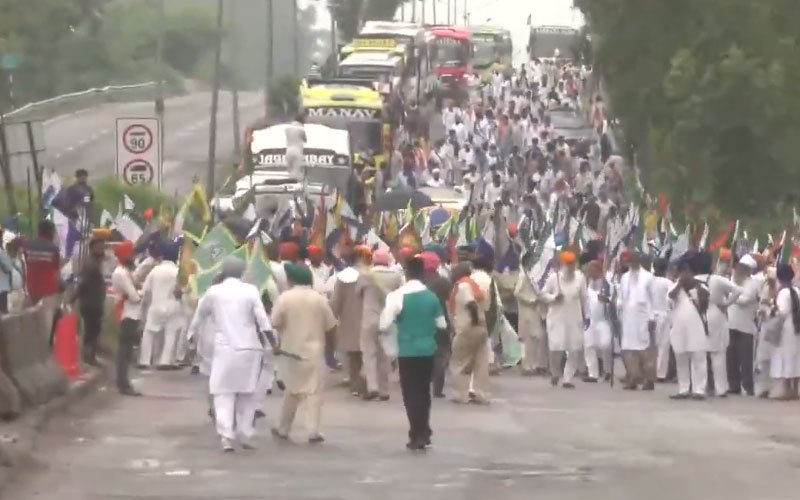
New Delhi, July 21: A large convoy of farmers from Punjab was prevented from entering Haryana on Tuesday after police blocked their march to Delhi, where they planned to participate in a Kisan Mahapanchayat opposing the proposed India-US bilateral trade agreement.
The farmers were stopped at the Shambhu border, where Haryana Police had deployed heavy security and erected multiple barricades to restrict movement towards the national capital. Following the blockade, protesters remained at the border and launched a sit-in, accusing authorities of curbing their constitutional right to hold a peaceful demonstration.
The security arrangements at the border brought back memories of the extensive barricading seen during the 2024 “Delhi Chalo-2” farmers’ movement, when similar measures were adopted to prevent protesters from reaching Delhi.
Farmer leader Tezveer Singh of the Bharatiya Kisan Union (Shaheed Bhagat Singh) claimed that the barricades had been placed inside Punjab’s territory. He also criticised the Punjab government for not intervening, alleging that it had failed to protect the interests of the protesting farmers.
While Punjab-based farmer groups remained stranded at the border, participants from several districts of Haryana, including Ambala and Kurukshetra, were able to continue their journey to the national capital.
The Mahapanchayat has been organised by the Desh Bachao Morcha, a platform bringing together farmer organisations from Punjab, Haryana and Himachal Pradesh. The coalition is demanding that the Central Government suspend negotiations on the proposed trade agreement with the United States until wider consultations are held with stakeholders.
Kisan Mazdoor Sangharsh Committee (KMSC) leader Sarwan Singh Pandher said farmer convoys representing the KMSC, Kisan Mazdoor Morcha (Punjab chapter), Azaad Kisan Morcha and BKU Ekta Sangharsh had travelled from different parts of Punjab before being stopped at the Shambhu border.
According to Pandher, an India-US joint statement issued in February 2026 proposed concluding the first phase of a broad-based bilateral trade agreement by the fall of 2026. Farmer organisations believe the proposed pact could extend beyond trade in goods to include agriculture, dairy, manufacturing, digital commerce, investment, government procurement, intellectual property rights and services.
Protesting groups argue that the agreement could result in greater access for subsidised American agricultural and dairy products to the Indian market. They fear such competition would place millions of India’s small and marginal farmers at a disadvantage and weaken domestic agricultural production.
The organisations have also questioned the transparency of the negotiations, alleging that the government has not made the details of the proposed agreement publicly available. They have demanded that all negotiation documents be released before any final decision is taken.
Farmer leaders further highlighted the importance of India’s dairy sector, which they say provides livelihoods to nearly 80 million rural families. They warned that any policy affecting the sector could have far-reaching consequences for dairy farmers, rural businesses, food processing units and other agriculture-linked industries.
The Desh Bachao Morcha has urged the Central Government not to sign the proposed trade agreement until meaningful consultations are held with farmers, dairy producers, workers, traders and other stakeholders who could be affected by its implementation.