

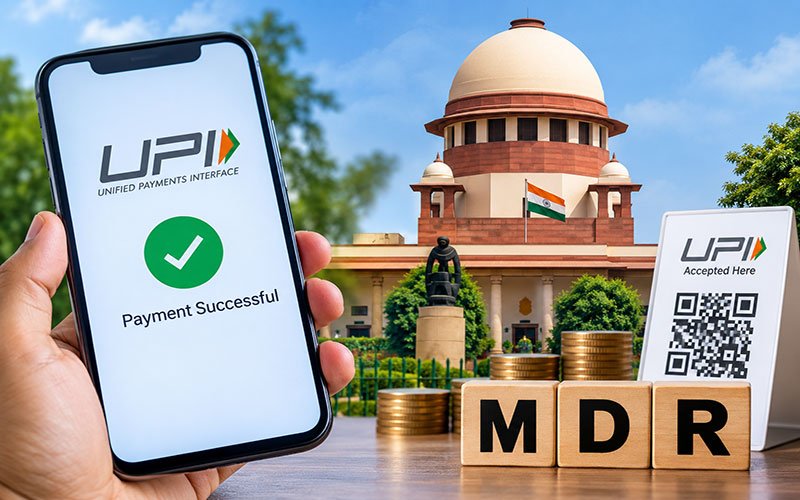
New Delhi: The proposed introduction of charges on certain high-value UPI transactions has come under judicial scrutiny, with the Supreme Court seeking responses from the Centre and key digital payment authorities while refusing to put the new framework on hold for the time being.
A bench headed by Chief Justice of India Surya Kant and comprising Justices Joymalya Bagchi and V. Mohana issued notices to the Union government, Reserve Bank of India (RBI), National Payments Corporation of India (NPCI) and the UPI & Services Steering Committee. The respondents have been directed to submit their responses within four weeks.
The proceedings relate to the Centre’s September 14, 2026 Gazette notification and a framework announced on September 15 concerning the introduction of Merchant Discount Rate (MDR) on specified person-to-merchant (P2M) UPI transactions above Rs 2,000.
The petition has been filed by advocate Anjan Datta through advocate Ashutosh Dubey. It challenges both the legal basis and the manner in which the proposed charges and transaction classifications have been formulated.
Appearing for the Union government, Additional Solicitor General N. Venkataraman told the court that the proposed charges are scheduled to begin from October 15. He submitted that approximately 96 per cent of transactions would not come under the levy.
The Centre has argued that the proposed MDR would operate as a settlement-related charge between payment aggregators and banks rather than as a source of revenue for the government. The law officer also pointed out that banks incur costs in processing electronic transactions and that other payment instruments, including debit and credit cards, already involve transaction charges.
According to the government, introducing a limited charge on certain high-value merchant transactions is intended to support the financial sustainability of the UPI ecosystem and help meet the costs associated with payment infrastructure and related services.
The government has also stated that charges applicable to essential services would be capped at Rs 5. It has maintained that the proposed mechanism should not be treated as an expropriation because the government would not receive the money collected through the MDR.
The petitioner, however, has raised questions over the criteria used to determine the transaction threshold, rates and classifications. The plea particularly challenges the Rs 2,000 threshold, pointing out that a payment of Rs 2,001 could attract a percentage-based charge while a transaction of Rs 2,000 would not.
The petition also questions the basis for the Rs 1 lakh monthly-receipt classification, different rates for particular sectors and the proposed cap of Rs 300 for transactions of Rs 75,000 and above. According to the petitioner, the government has not publicly disclosed sufficient empirical material explaining how these thresholds and classifications were determined.
Under the proposed framework, MDR of 0.4 per cent would apply to specified P2M UPI transactions above Rs 2,000, subject to the prescribed cap and separate rates for certain sectors.
The petitioner has argued that the framework creates a nationwide financial burden without adequate statutory safeguards. The plea states that the challenge is not against efforts to maintain a secure and resilient digital payment system, but against the manner in which the financial burden has allegedly been created and distributed.
Questions have also been raised over the role of the UPI & Services Steering Committee in determining rates and classifications. The petitioner has argued that significant decisions concerning financial charges should be based on clearly defined legislative standards, regulatory oversight and adequate public disclosure.
The plea has sought production of records connected with the decision, including the statutory basis for the framework, the constitution and authority of the steering committee, its decisions and minutes, and the legal basis for prescribing the MDR rates and determining how the charges would be distributed among participants in the payment ecosystem.
The petitioner has sought quashing or suspension of the framework to the extent that it imposes MDR on UPI transactions above Rs 2,000. As an alternative, the plea seeks reconsideration of the framework following transparent consultation, publication of relevant data and an impact assessment, particularly with safeguards for micro and small businesses.
During Monday’s hearing, the petitioner’s counsel requested an interim stay on implementation. The Supreme Court, however, declined to grant such relief at this stage.
The bench instead directed the concerned authorities to place the relevant facts and supporting material on affidavit and listed the matter for further hearing after four weeks.
The Centre has maintained that the revised framework is aimed at ensuring the long-term sustainability of the UPI ecosystem. The Union Finance Ministry has said that a limited charge on high-value merchant transactions could help fund payment infrastructure, cybersecurity and support mechanisms for smaller merchants in Tier III to Tier VI towns and rural areas.
The government has also reiterated that customers will not be charged for using UPI. Person-to-person transactions are expected to remain free regardless of the transaction amount.
According to the Centre, merchants receiving up to Rs 1 lakh per month through UPI QR codes would continue to have zero charges, while more than 95 per cent of merchant payments below Rs 2,000 would remain free.
The RBI has also backed the broader objective of strengthening the financial sustainability of the digital payments ecosystem while maintaining that UPI transactions will remain free for users.
The Supreme Court’s next hearing, after receiving responses from the Centre and the other respondents, is expected to provide further clarity on the legal basis and implementation of the proposed MDR framework.