

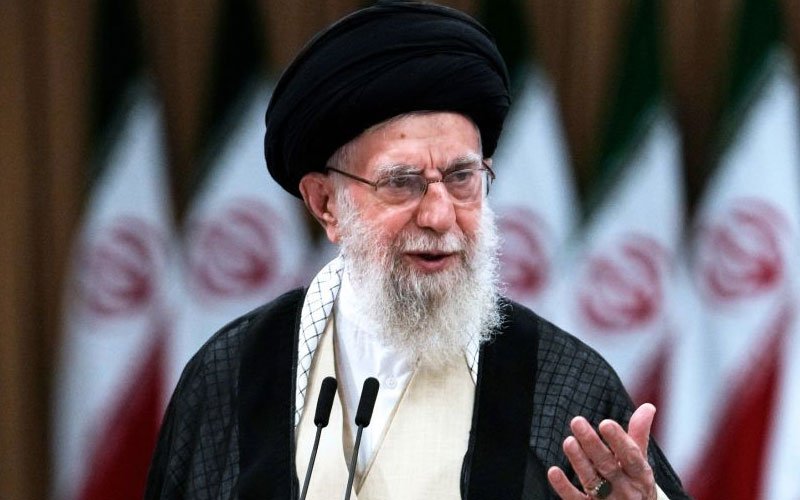
Iran’s state media on Sunday claimed that Supreme Leader Ayatollah Ali Khamenei has been killed following what was described as the most extensive joint US-Israeli military operation against Iranian targets in decades, an assertion that has sharply escalated tensions across the Middle East.
State broadcaster IRIB reported that the 86-year-old leader “attained martyrdom” after a series of coordinated airstrikes struck central Tehran in the early hours of Saturday. According to Iranian media, Khamenei was killed inside his office, with state television saying his presence there symbolised that he “stood among the people and at the forefront of responsibility” while confronting what Iranian officials often describe as “global arrogance.”
Israeli media outlets cited senior officials as saying Khamenei was killed when an Israeli strike hit his compound. The Times of Israel reported, quoting an Israeli official, that his body had been recovered, while Channel 12 said Prime Minister Benjamin Netanyahu had been shown images confirming the claim. Israeli authorities also said the compound had been destroyed during the operation.
The reports, if confirmed, would mark the assassination of only the second Supreme Leader of the Islamic Republic, following Ayatollah Ruhollah Khomeini. Khamenei had no formally designated successor, raising immediate questions about Iran’s political future and the risk of prolonged conflict amid Tehran’s repeated warnings of retaliation.
US President Donald Trump publicly acknowledged the operation, calling Khamenei’s reported death “the single greatest chance for the Iranian people to take back their country.” In posts on X and Truth Social, Trump said the United States had worked closely with Israel, describing the strikes as a decisive effort to eliminate what he called a long-standing threat and to prevent Iran from developing nuclear weapons.
Trump said advanced intelligence and tracking systems had monitored Khamenei’s movements, adding that Iranian leaders targeted in the operation “could do nothing” to evade the strikes. He reiterated calls for Iranians to challenge their leadership, while warning that “heavy and pinpoint bombing” would continue for as long as necessary to secure what he termed “peace throughout the Middle East and the world.”
Shortly after Trump’s statements, activity on the Iranian Supreme Leader’s official X account appeared to cast doubt on the claims. A brief post in Persian read: “In the name of Nami Haider (peace be upon him),” without further clarification, fuelling uncertainty over the situation.
Multiple sources cited by Reuters said other senior Iranian figures were also killed in the attacks, including Defence Minister Amir Nasirzadeh and Revolutionary Guards commander Mohammad Pakpour. Israel’s military said five additional high-ranking commanders were confirmed dead, among them Ali Shamkhani, a close adviser to Khamenei. Iranian media further reported that several members of Khamenei’s family were killed, including a daughter and a grandchild.
Iran condemned the strikes as unprovoked and illegal, and said it had responded by launching missiles toward Israel and several other countries, including Gulf states hosting US military bases.
Khamenei had ruled Iran since 1989, wielding ultimate authority over the government, armed forces and judiciary. Initially seen as a relatively weak figure after Khomeini’s death, he gradually consolidated power, marginalising reformist presidents and entrenching a hardline, anti-Western course. Analysts have described him as one of the most powerful Iranians of the past century, a leader whose uncompromising stance contributed to Iran’s international isolation.
In recent years, as protests intensified at home and pressure from Washington increased, Khamenei repeatedly rejected compromise. In January, amid renewed unrest and threats of US intervention, he vowed that Iran would not “yield to the enemy,” a message consistent with his decades-long defiance of the West.
As conflicting claims continue to emerge, the situation remains fluid, with the reported killing of Iran’s supreme leader threatening to redraw the region’s political and security landscape.