

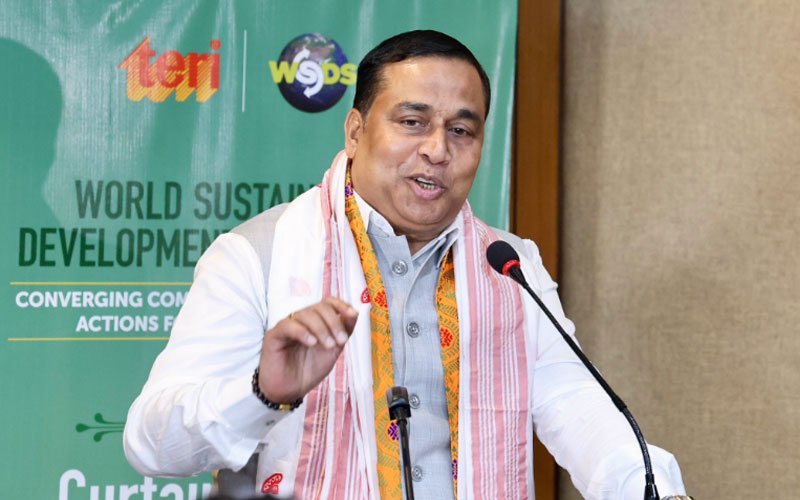
Guwahati: Guwahati took centre stage in discussions on sustainable development as Gauhati University and The Energy and Resources Institute (TERI) jointly organised a curtain-raiser programme for the World Sustainable Development Summit (WSDS) 2027 on September 9, 2026.
The programme was organised around the theme “Converging Commitments: Collaborative Actions for a Resilient Planet”, bringing together senior government officials, academic leaders and sustainability experts to discuss the growing need for coordinated action on environmental and climate-related challenges.
Assam Minister for Finance, Environment & Forest, and Mines & Minerals Jayanta Malla Baruah attended the event along with Gauhati University Vice-Chancellor Prof. Nani Gopal Mahanta and TERI Director General Dr. Vibha Dhawan.
Other prominent participants included Leena Nandan, former Secretary of the Ministry of Environment, Forest and Climate Change, Government of India and Distinguished Fellow, TERI; Taruna Idnani, Associate Fellow at TERI; Sazzad Alam, ACS, Joint Secretary, Government of Assam; and Ajay Tewari, IAS, Additional Chief Secretary, Government of Assam.
Speaking at the programme, Jayanta Malla Baruah highlighted the importance of ensuring that Assam’s economic progress remains aligned with environmental sustainability. Referring to the state’s long-term development vision, he said climate challenges cannot be addressed by governments alone and require cooperation among government institutions, industry, academia and society.
The minister also described WSDS as an important forum for translating sustainability commitments into concrete action. The 2027 edition of the summit is scheduled to be held in New Delhi.
Prof. Nani Gopal Mahanta placed emphasis on the value of traditional knowledge in addressing contemporary environmental challenges. He drew attention to practices developed by communities in Assam and the wider Northeast, citing the Chang Ghar of the Mishing community and the Dong Bandh system associated with the Bodo community as examples of indigenous approaches that can offer useful lessons for climate resilience.
The discussions highlighted the importance of combining modern sustainability strategies with locally developed knowledge and practices. Such approaches, participants noted, can play a role in building communities that are better prepared to respond to climate and environmental challenges.
The curtain raiser at Gauhati University has set the stage for the wider discussions surrounding WSDS 2027, which will bring together stakeholders to explore collaborative approaches towards sustainable development and a more resilient planet.