

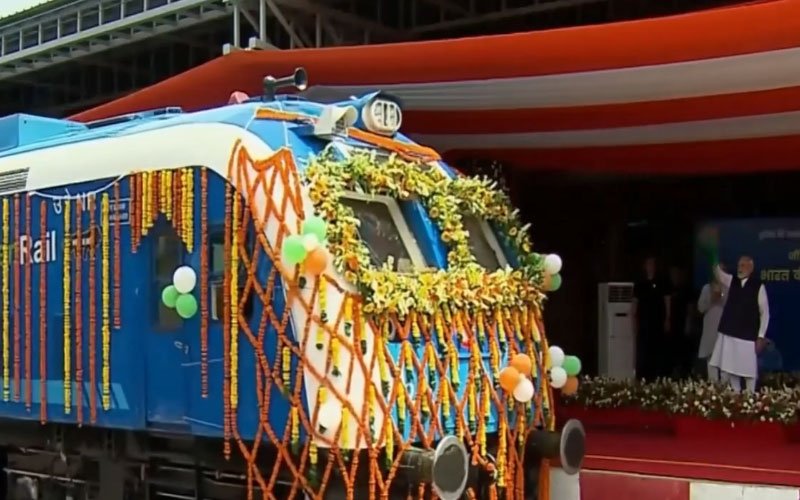
New Delhi: In a significant push towards green transportation, India on Friday launched its first hydrogen-powered train, marking the country’s entry into the growing list of nations adopting hydrogen fuel cell technology for rail travel. Prime Minister Narendra Modi flagged off the pilot service, which will run on the 89-kilometre Jind–Sonipat route in Haryana under Northern Railway.
The project represents the first use of hydrogen fuel cell technology in the Indian Railways network. Instead of relying on diesel, the train generates electricity through hydrogen fuel cells, producing only water as a by-product and offering a cleaner alternative for rail transportation. The initiative also includes the development of hydrogen storage and refuelling infrastructure to support regular operations.
Ahead of the launch, Prime Minister Modi said India had become one of the select nations to introduce hydrogen-powered trains, adding that the initiative would accelerate the adoption of clean technologies in the railway sector.
Developed as a pilot project, the hydrogen-powered train is expected to help Indian Railways evaluate the performance, efficiency and operational feasibility of hydrogen-based propulsion systems before considering wider deployment across the network.
The train comprises 10 coaches and is powered by a 1,200-kW hydrogen fuel cell propulsion system. It has been approved for operations at a maximum speed of 75 kmph, with a design speed of 110 kmph, and can accommodate around 2,600 passengers.
The service will operate between Jind Junction and Sonipat via Gohana Junction, stopping at several stations along the route, including Jind City, Pandu Pindara Junction, Lalit Khera Halt, Bhambhewa, Isapur Kheri Halt, Butana Halt, Khandrai Halt, Rabrah Halt, Lath Halt, Mohana, Barwasni Halt and Sonipat New.
The launch places India alongside countries such as Germany, Japan, China and the United States that are actively exploring hydrogen-powered rail transport. Germany became the first country to introduce hydrogen-powered passenger trains with the Alstom Coradia iLint, while Japan plans to begin operations of its hydrogen hybrid train, Hybari, by fiscal 2027. In the United States, California introduced its first hydrogen-powered passenger train, Zemu, in 2024.
Hydrogen-powered trains are considered a promising alternative for non-electrified railway routes because they produce zero tailpipe emissions while reducing dependence on fossil fuels. Officials expect the pilot project to generate valuable operational data that could shape the future adoption of hydrogen-powered trains across the Indian Railways network.
With the successful rollout of the pilot service, India has taken another step towards modernising its railway infrastructure while advancing its broader goal of promoting cleaner, low-carbon transportation solutions.