

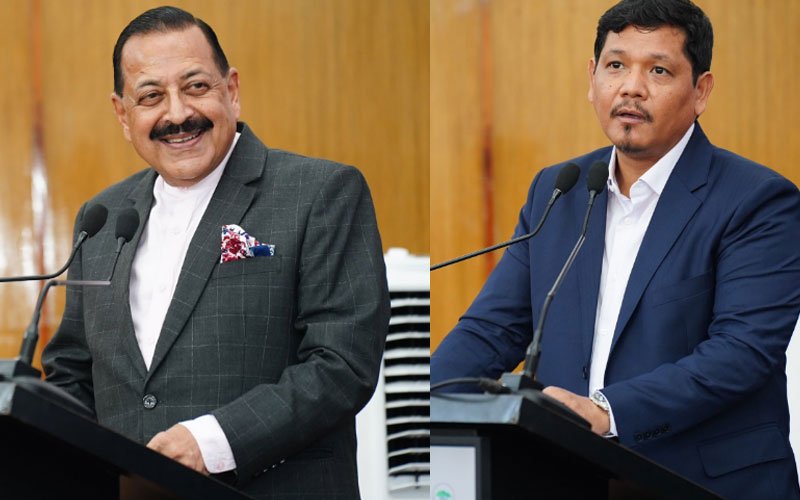
Shillong: Meghalaya Chief Minister Conrad K. Sangma on Monday said that meaningful administrative reforms require both innovation and a willingness to improve everyday governance, as he addressed the National Conference on “NextGen Administrative & e-Gov Reforms” in Shillong. The conference was attended by Dr. Jitendra Singh, Union Minister of State (Independent Charge) for Science and Technology and Earth Sciences, who is also Minister of State in the Prime Minister’s Office, Personnel, Public Grievances and Pensions, Atomic Energy, and Space.
Welcoming the Union Minister to Meghalaya, Sangma emphasised that the success of governance depends not only on introducing new policies but also on refining existing systems and ensuring that government services become more efficient, transparent and accessible to citizens. He said incremental improvements in administrative processes often have a greater long-term impact than large-scale reforms implemented in isolation.
Referring to Meghalaya’s governance initiatives, the Chief Minister highlighted programmes such as CM Connect, Cabinet Retreat, and citizen feedback mechanisms, describing them as important steps towards building a responsive and collaborative administration. According to him, these initiatives have reinforced the state’s belief that governance becomes more effective when public participation is encouraged, technology is effectively utilised and government departments work in close coordination.
Sangma also stressed that the true measure of governance lies in the positive change experienced by citizens. He urged public officials to remain committed to simplifying procedures, removing administrative bottlenecks and responding to public concerns with empathy and accountability, while continuously improving service delivery.
The conference, organised by the Department of Administrative Reforms and Public Grievances (DARPG) in association with the Government of Meghalaya, has brought together senior government officials, policymakers and governance experts from across India to deliberate on emerging trends in administrative reforms, digital governance and citizen-centric public services.
The deliberations are expected to focus on strengthening e-governance, promoting innovation in public administration and sharing best practices that can help governments deliver faster, more transparent and efficient services. The event also provides a platform for states and Union Territories to exchange experiences and explore collaborative approaches to modernising governance in the digital era.